Canopée at the IMO: four years of operational data
Nils Joyeux and Simon Watin presented four years of operating results from the vessel at IMO headquarters in London.
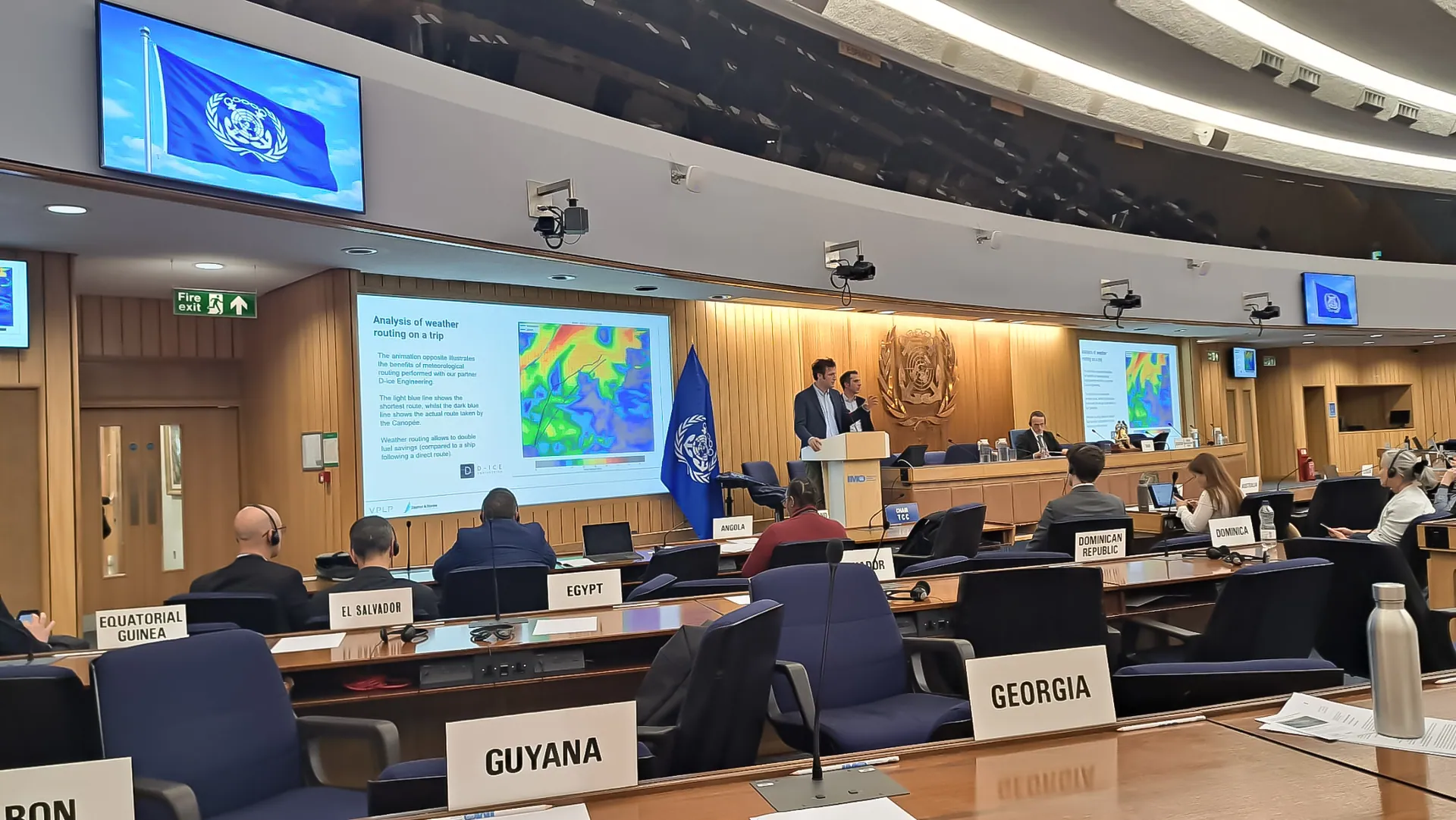
Nils Joyeux, co-founder and president of Zéphyr & Borée, and Simon Watin, president of VPLP Design, the naval architecture firm that co-designed Canopée, spoke at the headquarters of the International Maritime Organization (IMO) in London, at the invitation of France’s Directorate General for Maritime Affairs, Fisheries and Aquaculture (DGAMPA).
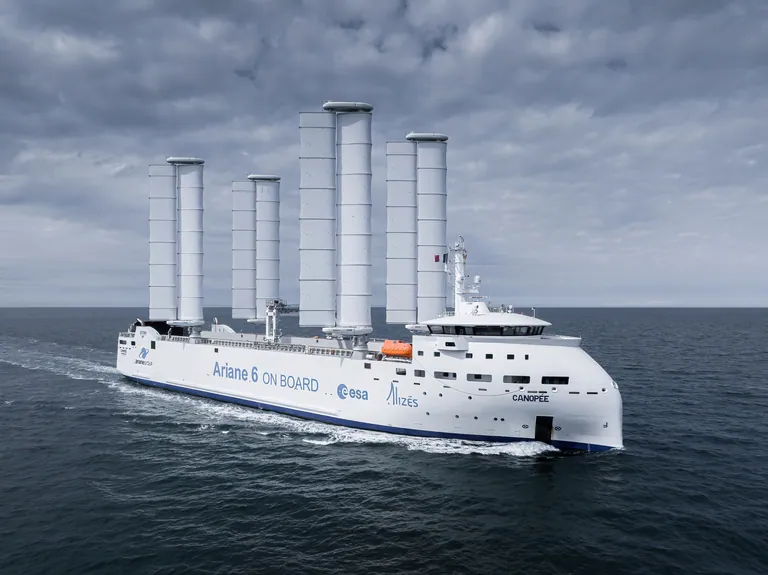
Before the delegations meeting for the 84th session of the Marine Environment Protection Committee (MEPC 84), they presented four years of operating results from the vessel. Canopée now yields measured data on the reliability, energy performance and operating conditions of wind propulsion at industrial scale. Their message to the committee: that evidence exists, and scaling the sector up now depends on a stable regulatory framework.
What four years of operation show
Delivered in 2022 to serve ArianeGroup’s supply chain, Canopée provides one of the most complete operating records available for a wind-assisted cargo vessel in commercial service.
The results cover two points. The automated wingsails have held their operating duty over four years, under demanding sea conditions and a fixed schedule. The predictive weather routing developed with D-ICE Engineering doubles fuel savings compared with a direct route, adjusting the track to wind conditions, heading and the vessel’s point of sail, without affecting the service’s transit times.
The Net-Zero Framework under discussion
Approved in principle by the MEPC in April 2025, the Net-Zero Framework has yet to be formally adopted by IMO member states. Following the adjournment of October 2025, MEPC 84 reopened work aimed at restoring consensus.
The framework rests on two mechanisms: a fuel standard based on carbon intensity reduction targets, and a global emissions pricing mechanism. Adopting them would narrow the cost gap between fossil fuels and low-carbon alternatives, which changes the economics of wind propulsion directly.
Securing the investment case
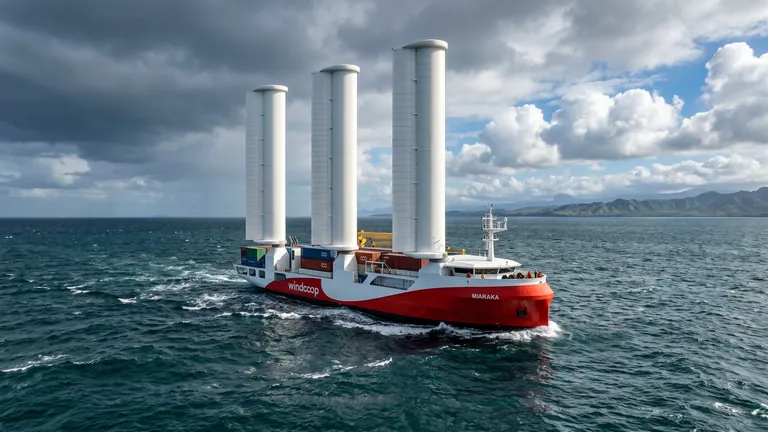
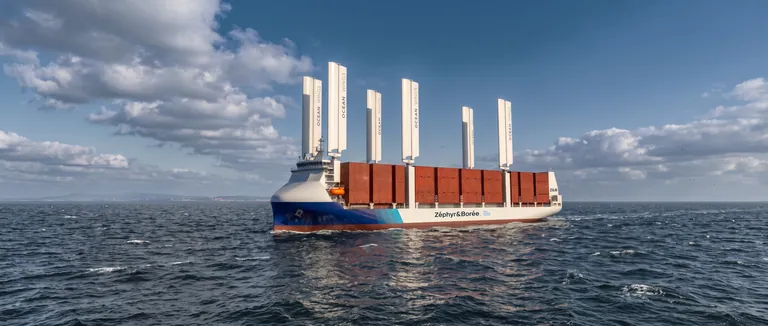
The technology is ready for wider deployment. Zéphyr & Borée is building a 210 TEU container ship for the Windcoop cooperative, with delivery scheduled for 2027, and is developing a project for three 2,700 TEU container ships.
Scaling up carries a cost. Installing wind propulsion systems represents around 10 million dollars of additional CAPEX on a large container ship. As with any maritime asset, these vessels are financed over long horizons. Shippers and financial partners will commit over those horizons where regulatory visibility extends just as far.
From proof to scale
Four years of operation have tested wind propulsion against the realities of commercial shipping: schedule reliability, equipment performance, route optimisation and fuel consumption. Zéphyr & Borée and VPLP Design brought these results before the delegations so that the decisions ahead rest on data from vessels in service.
What happens next depends on the visibility that states give to shipowners, shippers and financiers.