Skip to content

FAQ

Frequently asked questions

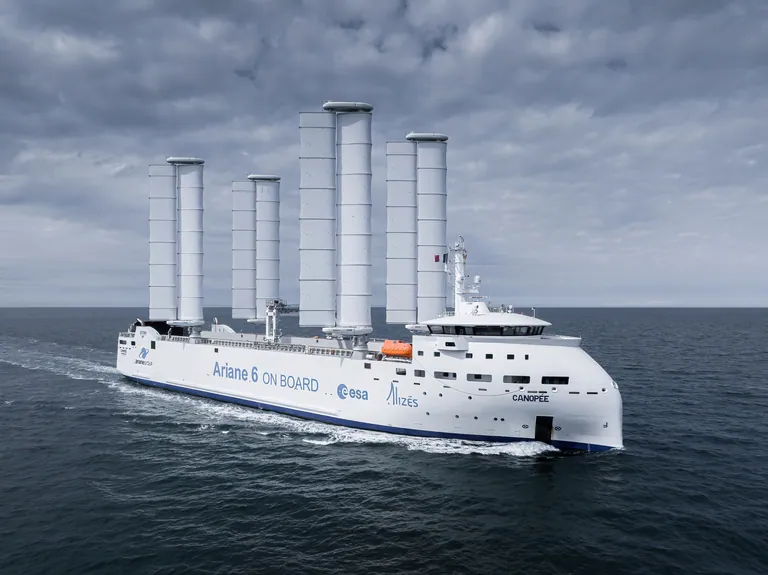
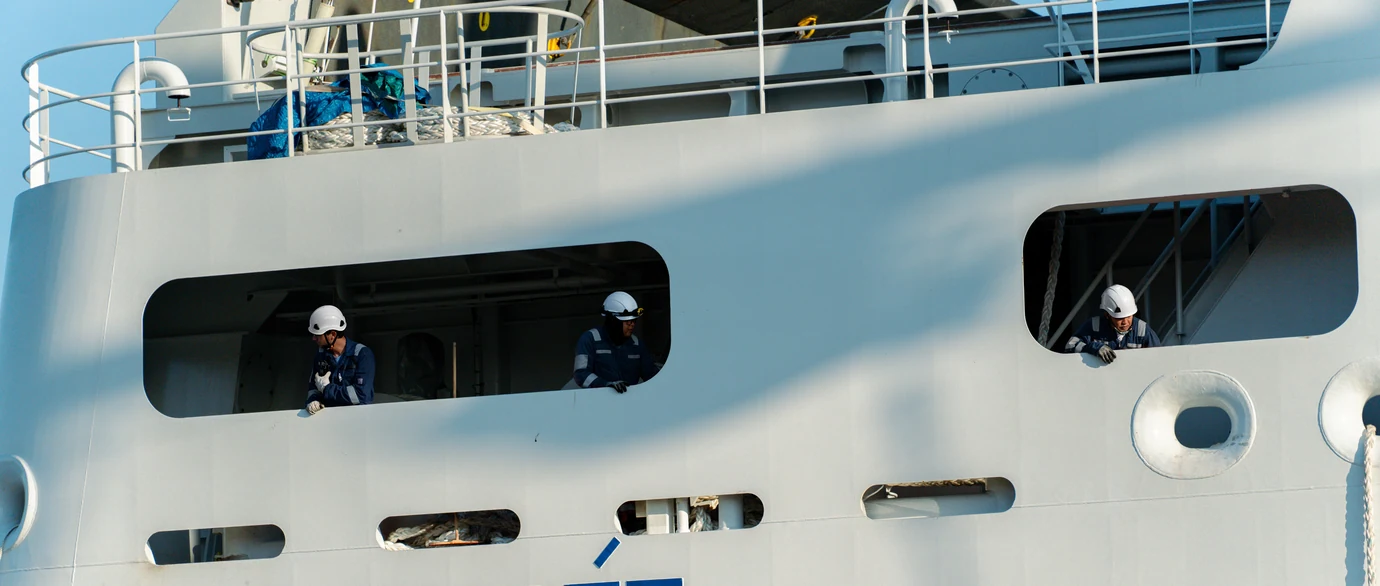
Crew members at the windows of Canopée’s bridge

If you cannot find the answer to your question here, contact us!

The behaviour of a wind-assisted cargo vessel under extreme conditions relies on three distinct factors, documented under actual operating conditions with Canopée.

Automated stowage. The sails are equipped with sensors that continuously measure apparent wind speed. Above a threshold of 35 to 40 knots, depending on the manufacturer, they are automatically stowed without any manual intervention from the crew.

Controlled residual windage. Once stowed, the sails generate minimal residual windage. In lateral gusts of 100 knots, the calculated heel angle for Canopée is approximately 5.5°: a marginal impact on stability, comparable to that of an equivalent vessel without sails.

A structured regulatory framework. The design and operation of sails on merchant vessels are governed by the International Maritime Organization (IMO) guidelines on Wind-Assisted Propulsion Systems (WAPS), which set out the requirements applicable to shipowners and equipment manufacturers.

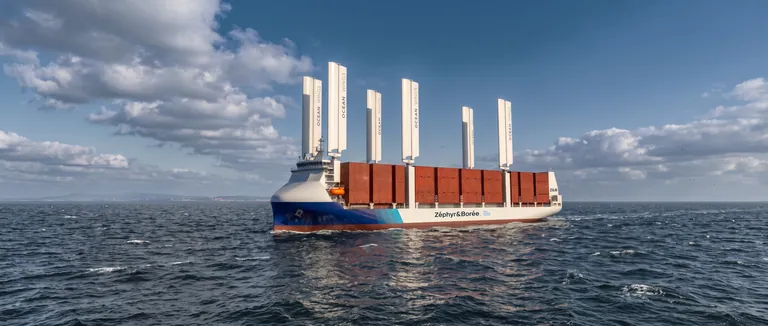
No. At Zéphyr & Borée, wind propulsion complements the main engine; it never replaces it. The estimated time of arrival (ETA) remains the voyage’s input parameter, while fuel savings are the output variable. In favourable wind conditions, the engine’s contribution decreases. If the wind is light or unfavourable, the engine compensates fully. After four years of commercial operation, Canopée has recorded zero delays attributable to wind propulsion across all its transatlantic crossings.

On a newbuild vessel, integrating a wind-propulsion system represents an additional cost of approximately 15% of total CAPEX. Rigid-wing systems are priced between €1 million and €1.5 million per unit, depending on the manufacturer and sail area.

Return on investment. At the current price of marine gas oil (MGO), approximately $800 per tonne, the return on investment ranges from five to eight years, depending on the configuration.

An equation that will continue to improve. This payback period is expected to shorten as regulatory pressure on maritime transport emissions increases, particularly through the EU Emissions Trading System (EU ETS) and FuelEU Maritime.

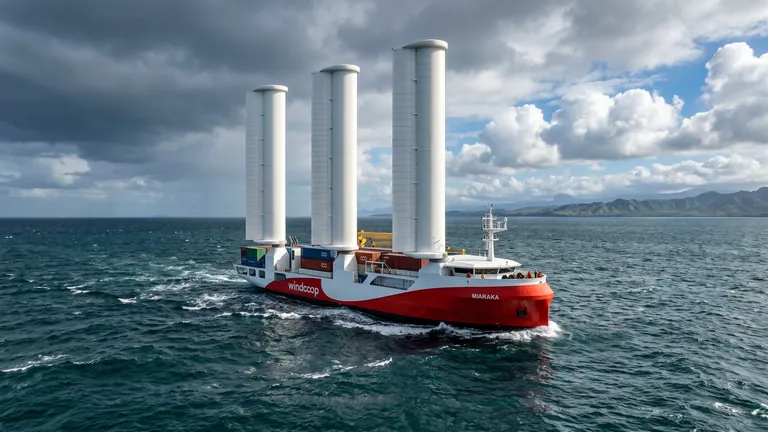
No, in both cases. Modern sails, including rigid wings, Flettner rotors and suction sails, are fully automated. They orient themselves according to the wind and the vessel’s heading, much like a wind turbine, with simple on/off logic.

No additional crew members are required, and no previous sailing experience is necessary. At Zéphyr & Borée, onboard training, comparable to the training provided for any new piece of equipment, is sufficient for operation.

No. When approaching a port, the sails are systematically stowed and secured before the vessel enters the navigation channel, leaving the deck completely clear. Managing the sails in port is comparable to operating a conventional vessel equipped with cranes.

On Canopée, 35-metre components are loaded by crane in the immediate vicinity of the masts. In four years of operation and several hundred cargo-handling operations, no sail has been damaged.

Wind propulsion is suitable for most deep-sea routes, where the vessel spends enough time at sea to benefit from consistent winds. It can accommodate a wide range of cargo profiles, including breakbulk, out-of-gauge cargo, containers, Ro-Ro vessels and multipurpose vessels (MPP).

At Zéphyr & Borée, we assess the eligibility of your route during the de-risking study, based on wind statistics and your operating profile.

Performance is quantified upfront through weather routing based on five years of meteorological data, then measured voyage by voyage once the vessel enters operation.

Depending on the project, we contractually commit to performance guarantees and offer a “pay as you save” remuneration model, under which our remuneration depends directly on the fuel savings actually achieved.

Zéphyr & Borée offers two possible pathways, depending on the type of project.

A newbuild vessel. The de-risking study takes a few weeks. Design and construction follow, with an overall timeframe of approximately 24 to 36 months before the vessel enters service.

An existing vessel through chartering or retrofit. Converting a vessel already in the fleet is significantly faster, taking approximately 12 months from initial contact to entry into service.

Looking to decarbonise
your shipping? Let’s talk.

Contact us